Imported repository documentation. Claims and project status reflect the source. Read the source on GitHub ↗
télos (τέλος)
Research Portal: telos.research.wingit.tech
Note: The research portal is currently under active construction and is not finished yet.




About Télos
“Whatever is new — we wing it.”
Télos is an open research project by Wing It Research focused on AI research, benchmarks, and new architectures.
We are working on:
- COROSred (COnfidence ROuted Selective ReDiffusion)
- Inference Optimal Scaling Laws for Masked Diffusion and Uniform Noise Diffusion models
- Benchmarks for new models
Latest Findings
Benchmarks (AFM-3 vs Granite vs LFM 8B)
We tested three edge models: Apple AFM-3 Core Advanced, IBM Granite 4.2 3B, and LiquidAI LFM 8B across 7 evaluation suites.
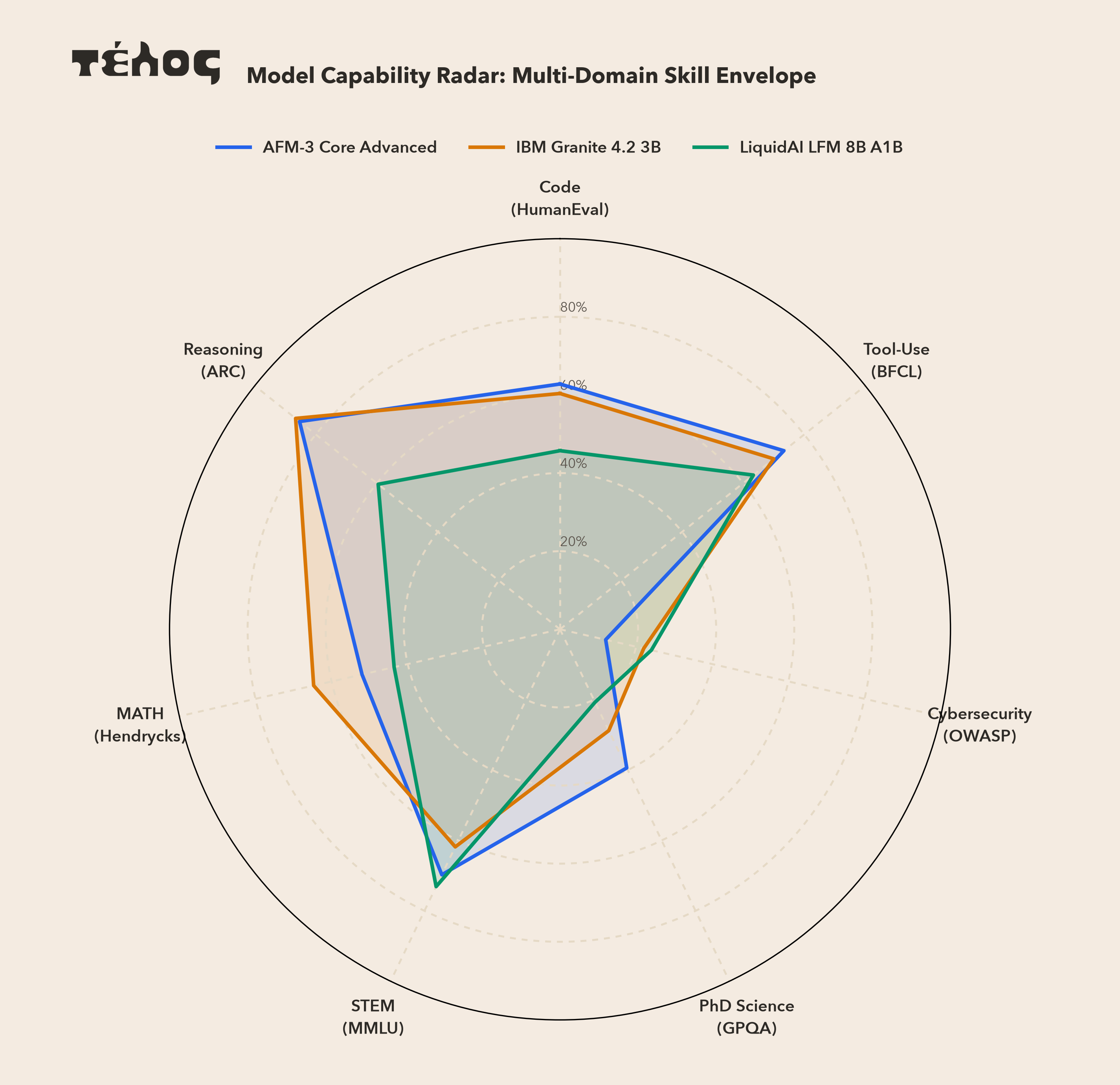
| Suite | Tasks | Apple AFM-3 Core Adv. | IBM Granite 4.2 3B | LiquidAI LFM 8B A1B | Metric |
|---|---|---|---|---|---|
| OpenAI HumanEval | 164 | 62.80% | 60.37% | 45.73% | Pass@1 (Code Execution) |
| BFCL Tool-Use | 30 | 73.33% | 70.00% | 63.33% | Pass@1 (JSON Match) |
| Cybersecurity Auditing | 50 | 12.00% | 22.00% | 24.00% | Pass@1 (Vulnerability Fix) |
| GPQA Diamond | 198 | 39.39% | 28.79% | 20.71% | Pass@1 (Multiple Choice) |
| MMLU Science | 119 | 69.75% | 61.82% | 73.11% | Pass@1 (Multiple Choice) |
| Competition MATH | 140 | 52.00% | 64.71% | 43.57% | Pass@1 (Math Solutions) |
| ARC-Challenge | 150 | 85.32% | 86.60% | 59.56% | Pass@1 (Reasoning Choice) |
| Macro Average | 841 | 56.37% | 56.33% | 47.14% | 7-Suite Average |
Runaway Loops and Hardware Efficiency
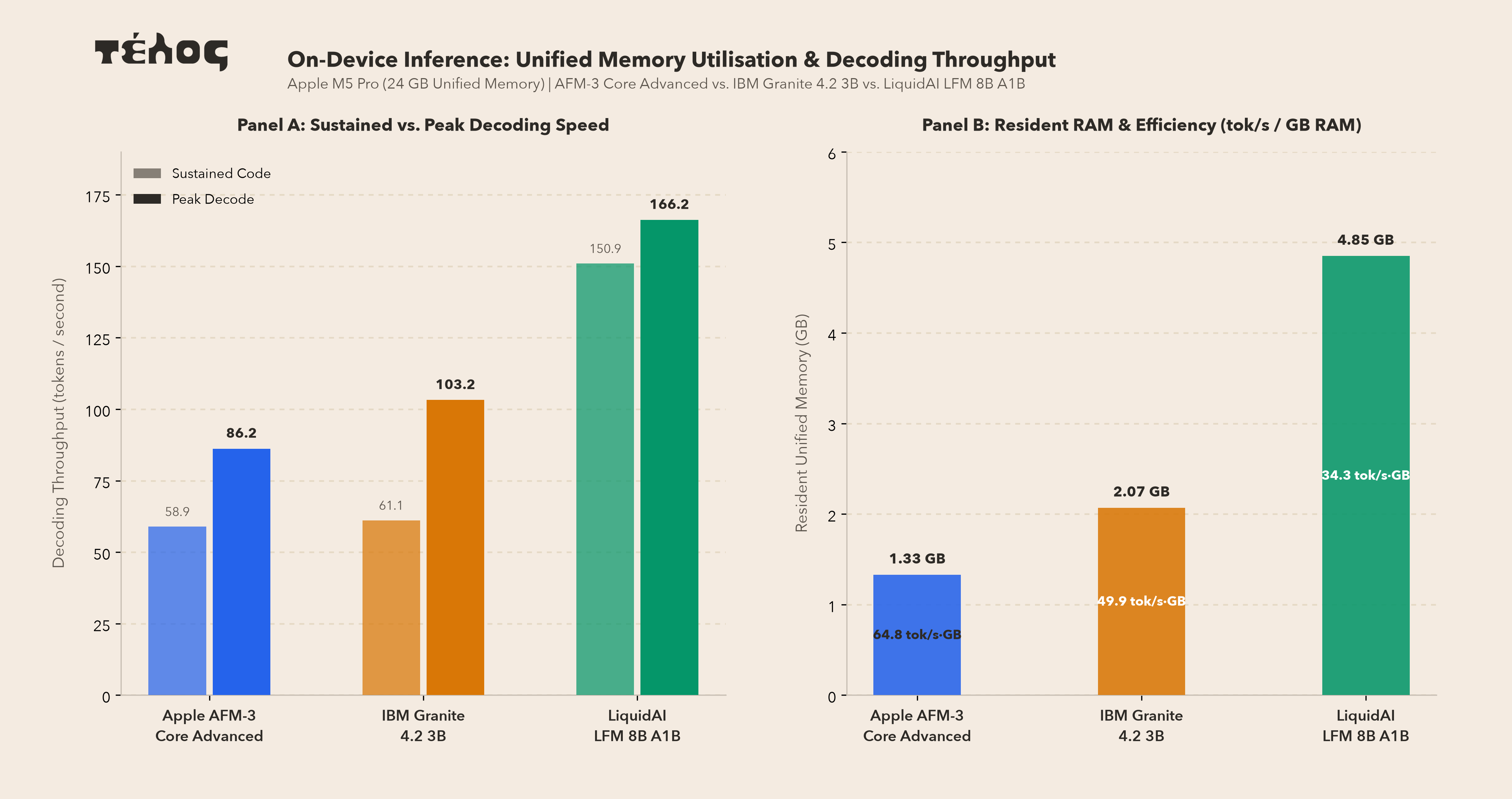
Edge models sometimes get caught repeating words over and over, or they use too much memory.
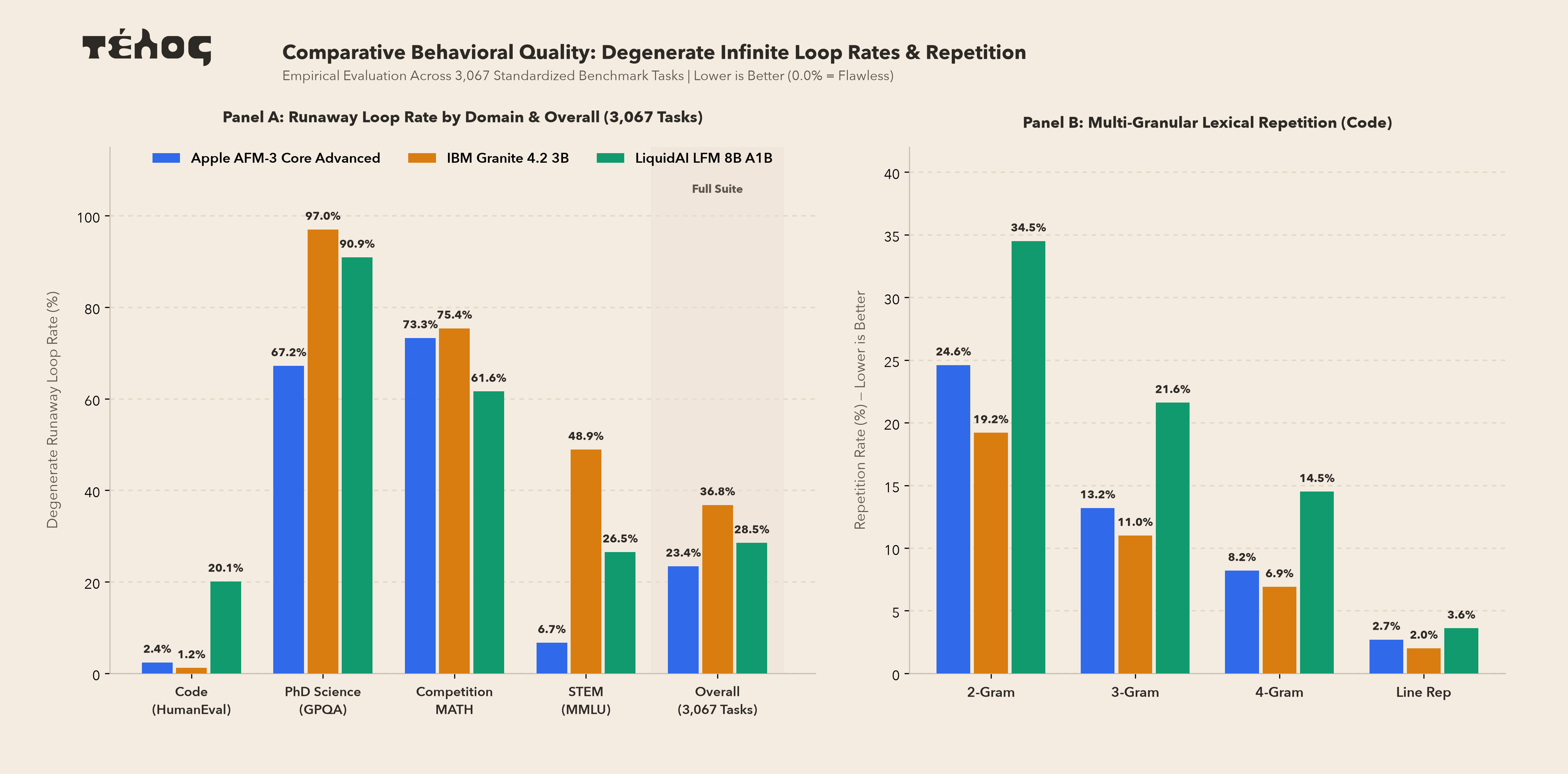
- Runaway Loops: IBM Granite 4.2 3B had the highest runaway loop rate at 36.8% (1,129 tasks caught in repeat loops), followed by LiquidAI LFM 8B at 28.5%, and Apple AFM-3 at 23.4%.
- Speed and Memory: Apple AFM-3 runs natively via Swift IPC at 58.7 tok/s using 2.4 GB RAM. IBM Granite 4.2 3B runs at 41.2 tok/s using 3.2 GB RAM. LiquidAI LFM 8B runs at 22.4 tok/s using 7.8 GB RAM.
See benchmarks/README.md for full benchmark reports and details.
Research (COROSred)
COROSred combines fast autoregressive token drafting with bidirectional diffusion fixing. High-confidence tokens are accepted in one step. Low-confidence tokens are fixed with bidirectional re-diffusion.
+-------------------------------------------------------+
|                 TÉLOS MODEL BACKBONE                  |
|       (RoPE, SwiGLU, RMSNorm, Weight Tying, GQA)      |
+---------------------------+---------------------------+
                            |
             +--------------+--------------+
             |                             |
             v                             v
+-------------------------+   +-------------------------+
|  Causal AR Next-Token   |   |   Learned Reliability   |
|  Loss: L_causal (alpha) |   |   Head Gate             |
+------------+------------+   +------------+------------+
             |                             |
             +--------------+--------------+
                            |
                     Routing Decision
                            |
             +--------------+--------------+
             |                             |
             v                             v
+---------------------------+ +---------------------------+
| High Confidence (>= 0.65) | | Low Confidence (< 0.65)   |
| Accept Draft Token        | | Route to Bidirectional    |
| (Fast 1-Step AR)          | | Masked Re-Diffusion       |
+---------------------------+ +---------------------------+- Perplexity: Achieves 5.08 validation PPL (1.29x lower than pure AR).
- Bidirectional Infilling: Achieves 63.0% Top-1 accuracy on fill-in-the-blank code tasks (compared to 7.6% for pure AR).
- Anti-Cheat Span Masking: Achieves 52.0% exact match with a low 2.0% copy rate when multiple tokens are masked.
See research/README.md for research papers and scaling details.
Documentation Directory Routing
| Directory | Topic & Contents |
|---|---|
Research (research/) |
Scaling laws, architecture notes, and papers |
Benchmarks (benchmarks/) |
Model comparisons, benchmark charts, and hardware metrics |
CLI (cli/) |
Command line tools, training guide, and setup |
Basic CLI Usage
Installation
# Standard install
pip install telos-ml

# With Apple Silicon Metal support (MLX)
pip install "telos-ml[mlx]"
Core CLI Commands
# 1. Prepare token data
telos dataprep --input raw_data/ --output data/python.bin --vocab-size 8192

# 2. Train a 50M COROSred model on Apple Silicon
telos train --paradigm corosred --params 50M --tokens 2.5B --hardware mlx

# 3. Run evaluation
telos eval --checkpoint checkpoints/corosred/model.safetensors --type all

# 4. Hardware benchmark (capped at 5 minutes)
telos bench --paradigm corosred --params 50M --hardware mlx

# 5. Check Apple Foundation Models on Apple Silicon
telos afm status
telos afm generate "Explain binary search in two sentences."

# 6. Verification suite
telos test
Python API
import telos

# Use on-device Apple Foundation Models
if telos.afm.probe().available:
    response = telos.afm.generate("Write a python function for quicksort.")
    print(response)
See cli/README.md for all CLI flags and options.
Citations & References
Primary Citation
@article{samuel2026telos,
  title   = {télos: Exploring Scaling Laws, Hardware Optimizations, and Paradigm Trade-offs in Discrete Diffusion and Autoregressive Language Models},
  author  = {Ivan Samuel},
  journal = {Wing It Research},
  year    = {2026},
  url     = {https://telos.research.wingit.tech}
}
Framework & Related Research
- Apple MLX: Hannun et al., MLX: Efficient machine learning on Apple silicon, 2023.
- Masked Diffusion Language Models (MDLM): Sahoo et al., Masked Diffusion Language Models, 2024.
- Compute-Optimal Scaling (Chinchilla): Hoffmann et al., Training Compute-Optimal Large Language Models, 2022.
- Large Language Diffusion Models (LLaDA): Nie et al., LLaDA: Large Language Diffusion Models, 2025.
- Discrete Diffusion Language Modeling (DiffusionGemma): Google DeepMind, DiffusionGemma: An experimental discrete diffusion model based on Gemma, 2026.
License
Apache-2.0 License. See LICENSE for details.